

Ask an agent to fix a failing test and two very different failures can look almost identical from the outside.
The first agent thinks for four seconds, edits the first plausible file, and declares victory while the suite is still red. The second produces a careful diagnosis of the root cause, explains every tradeoff, and then stops without changing anything.
The first agent needed more reasoning. The second needed more follow-through.
Most model controls treat those as the same problem. They are not.
Two dials, not one
Reasoning controls are valuable because not every request deserves the same amount of deliberation. A formatting change should stay fast. A subtle architecture decision should not. Giving a person control over that tradeoff makes a model more predictable and often more efficient.
But thought is only one budget an agent spends.
An agent also spends a budget of action. It chooses how broadly to inspect, how many hypotheses to test, whether to run the suite, whether to repair a second failure, and whether the task ends with advice or with a finished artifact.
| Control | Governs | Typical question |
|---|---|---|
| Reasoning effort | Depth of deliberation before and between actions | How carefully should the model think? |
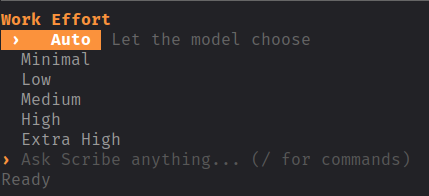
| Work effort | Breadth and persistence of execution | How far should the agent carry this? |
A model can reason deeply and still act timidly. It can also reason briefly and carry out a long but routine migration. Coupling the controls forces users to buy more of one behavior every time they need more of the other.
GRaPE and CRePE separate them.
Four useful modes
The distinction becomes clearer when the dials are considered together.
Low reasoning, low work
Good for direct questions, small rewrites, and quick transformations. The model should answer without turning a five-second request into a project.
High reasoning, low work
Good for review, diagnosis, strategy, and decisions where the deliverable is understanding. The model may inspect carefully, but it should not begin changing a system the user only asked it to analyze.
Low reasoning, high work
Good for clear mechanical execution. Rename the field everywhere, update the generated files, run the checks, and report the finished result. The work is broad, but the decision space is narrow.
High reasoning, high work
Good for ambiguous bugs, architecture changes, migrations, and project exploration. The model needs to form a theory, inspect evidence, act, observe what changed, and continue until the actual outcome is verified.
These are different operating modes, not quality levels. More is not always better. Control means choosing the mode the task deserves.
The stop condition is part of intelligence
Agent quality is often discussed as though choosing the next action were the entire problem. In practice, choosing when to stop is just as important.
Weak agents stop when they have produced something plausible. Dependable agents stop when the requested state has been reached and checked. That may require reading an error after the first fix, revisiting the plan, or admitting that the evidence does not support the original hypothesis.
Work effort gives that persistence an explicit place in the interface. It tells the system whether a useful response means a suggestion, an attempted change, or a verified deliverable.
Why this matters for open models
Hosted systems frequently tune this balance behind the API. Users receive the lab's chosen behavior, even when the task calls for something else.
Open models can make the control visible. A person who understands the cost, urgency, and risk of the task should be able to decide how much thought and how much follow-through it deserves.
That visibility also makes evaluation more honest. A model should not receive credit for a beautiful plan when the task asked for working code. It should not be punished for avoiding a large implementation when the user requested analysis only.
Careful thought does not automatically produce thorough action. Useful agents need both, separately and on purpose.