

An open model release often ends at the exact moment a user expects the experience to begin.
The weights arrive. The model card explains the template. An inference snippet proves that tokens come back. Then every practical question is handed to the person downloading it.
How should files enter the context? Which tool result should remain visible? What happens when reasoning takes thirty seconds? Can the model create an artifact instead of pasting a wall of code? How does a person control the amount of thought and the amount of work? What lets two people collaborate around the same model response?
Those are not decorative product questions. They decide whether the model becomes useful.
The last mile is the hard mile
When a lab stops at the release, every user rebuilds the last mile alone, accepts somebody else's generic implementation, or never reaches the model's real capability. The weights may be available immediately while usefulness remains hidden behind weeks of integration.
Hosted labs understand this. Their models arrive inside chat products, coding agents, APIs, voice interfaces, and media tools. The product is not wrapping paper around the intelligence. It teaches people what the intelligence can do and gives the model the environment required to do it.
Open labs should be equally ambitious about that layer.
An interface is a capability decision
Every product surface makes claims about the model.
A plain text box claims the model mainly answers. A file picker claims it can interpret external context. A terminal tool claims it can act. A visible reasoning control claims users should shape the cost and depth of deliberation. An artifact panel claims the output should sometimes be a thing, not another message.
If the interface cannot express a capability, most users will never discover it. If the model cannot support the interface reliably, the product exposes the weakness immediately.
That tension is useful research.
SLAI builds the layer that closes it:
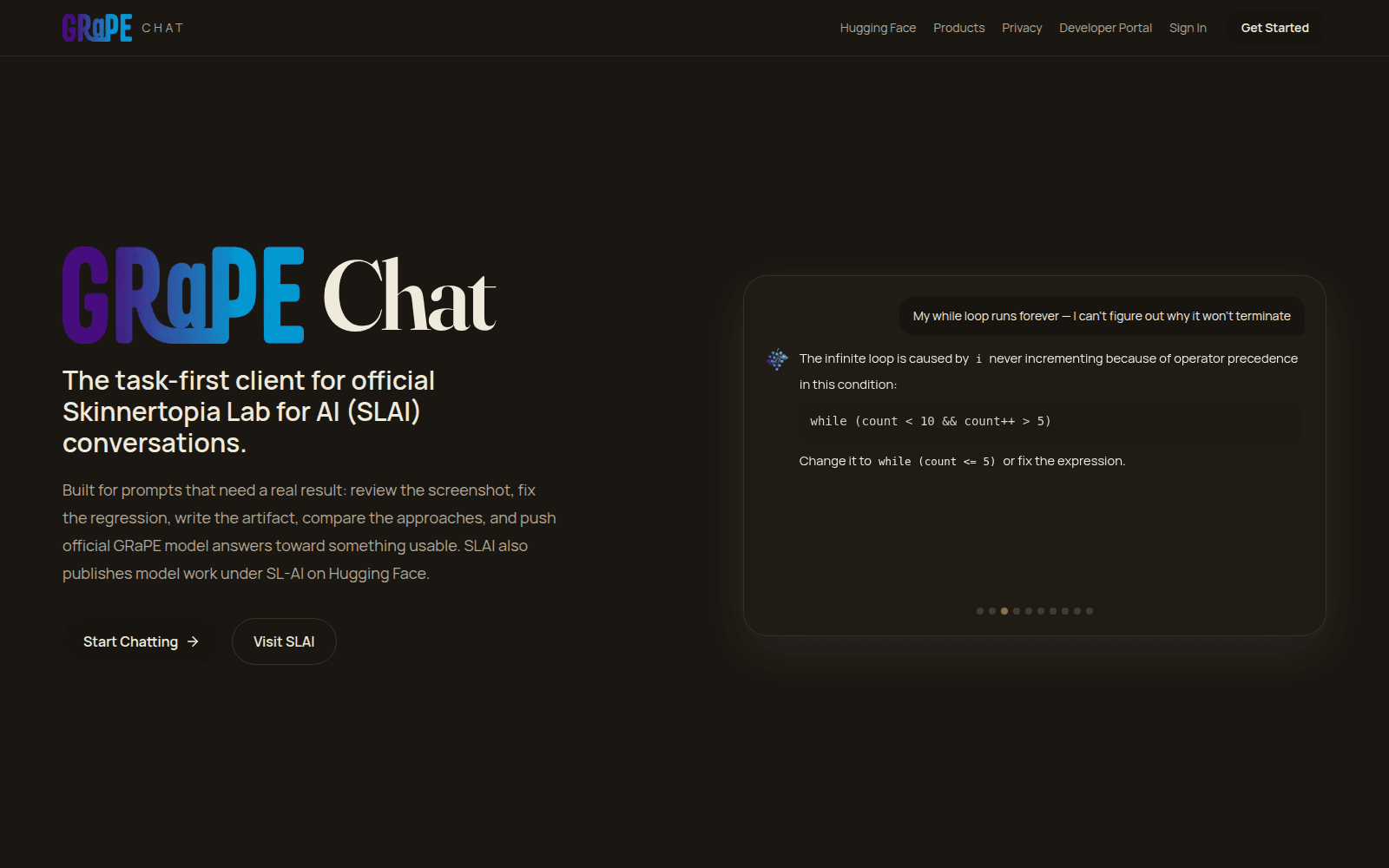
- GRaPE Chat is the hosted surface for models, tools, artifacts, files, visible reasoning, sources, images, and collaborative Vines in one conversation.
- Scribe takes the same direction into the terminal, where the work is a repository and the deliverable is a diff.
Neither product is an afterthought bolted onto a release. They are environments for discovering what the models can do, where they fail, and which controls make them easier to trust.
The product and model flywheel
The relationship runs in both directions.
- A product asks the model to perform a complete workflow.
- The workflow exposes a failure that a benchmark did not capture.
- The failure becomes a training, prompting, tooling, or evaluation target.
- A better model makes a more capable product possible.
- The new capability creates a harder and more useful workflow.
This is why SLAI develops models and products as one system. The product tells us what the model must become. The model tells us what the product can dare to offer.
Democratize the whole stack
Publishing weights democratizes intelligence. Publishing the interfaces, controls, and workflows around them democratizes capability, the ability to point that intelligence at real work and depend on the result.
The open ecosystem deserves products with taste, strong defaults, careful controls, and a clear point of view. It deserves tools that make an open model feel like the beginning of a workflow rather than the end of a release announcement.
SLAI is building both.