
A language model sees a prompt. An agent has to see a situation.
That difference sounds small until a task depends on facts the user did not include because the project already contains them. The relevant decision may be in a configuration file, a failing test, an image, an earlier migration, or a convention repeated across twenty components.
Answering from the prompt is generation. Finding and using the missing context is project exploration.
The prompt is a starting point
People rarely describe an entire project when they ask for help. They describe the part that hurts.
"The upload is broken" does not explain the storage provider, request limit, reverse proxy, authentication layer, or browser behavior. "Add dark mode" does not identify the existing token system, persisted preference, server rendering path, or contrast problems hidden inside a modal.
A dependable agent has to discover the rest without turning exploration into aimless wandering.
Observe, decide, act, verify
Project work repeatedly moves through four stages.
Observe
Inspect the environment before proposing the change. Read the files that define the behavior, find the consumers, reproduce the failure, and separate evidence from assumptions.
Decide
Choose a path that fits the actual project. A technically valid answer can still be wrong when it ignores local architecture, user intent, or an existing convention.
Act
Use the available tools to change the state of the project. The deliverable may be code, a document, an image, a model configuration, or a tested deployment.
Verify
Look at what happened. Run the checks, inspect the output, follow the real request path, and compare the result to the user's goal. Verification is not ceremony after the work. It is how the agent learns whether the work is finished.
These stages are a loop. A failed verification creates new evidence, which may change the decision and require another action.
Exploration needs boundaries
More inspection is not automatically better. An agent that reads the entire repository before changing one label is wasting time. An agent that edits the first matching string may miss the system that generates it.
Good exploration is shaped by the task:
- Start with the exact runtime path, file, screenshot, or error the user placed in scope.
- Expand outward when evidence shows another component controls the behavior.
- Preserve unrelated work and existing project state.
- Stop exploring when the implementation can be justified and verified.
This is one reason work effort matters separately from reasoning effort. The system needs a way to express how broadly and persistently it should investigate, not only how long it should deliberate.
Products make exploration real
Project exploration cannot be evaluated through isolated text completion alone. The model needs tools and an environment where observations have consequences.
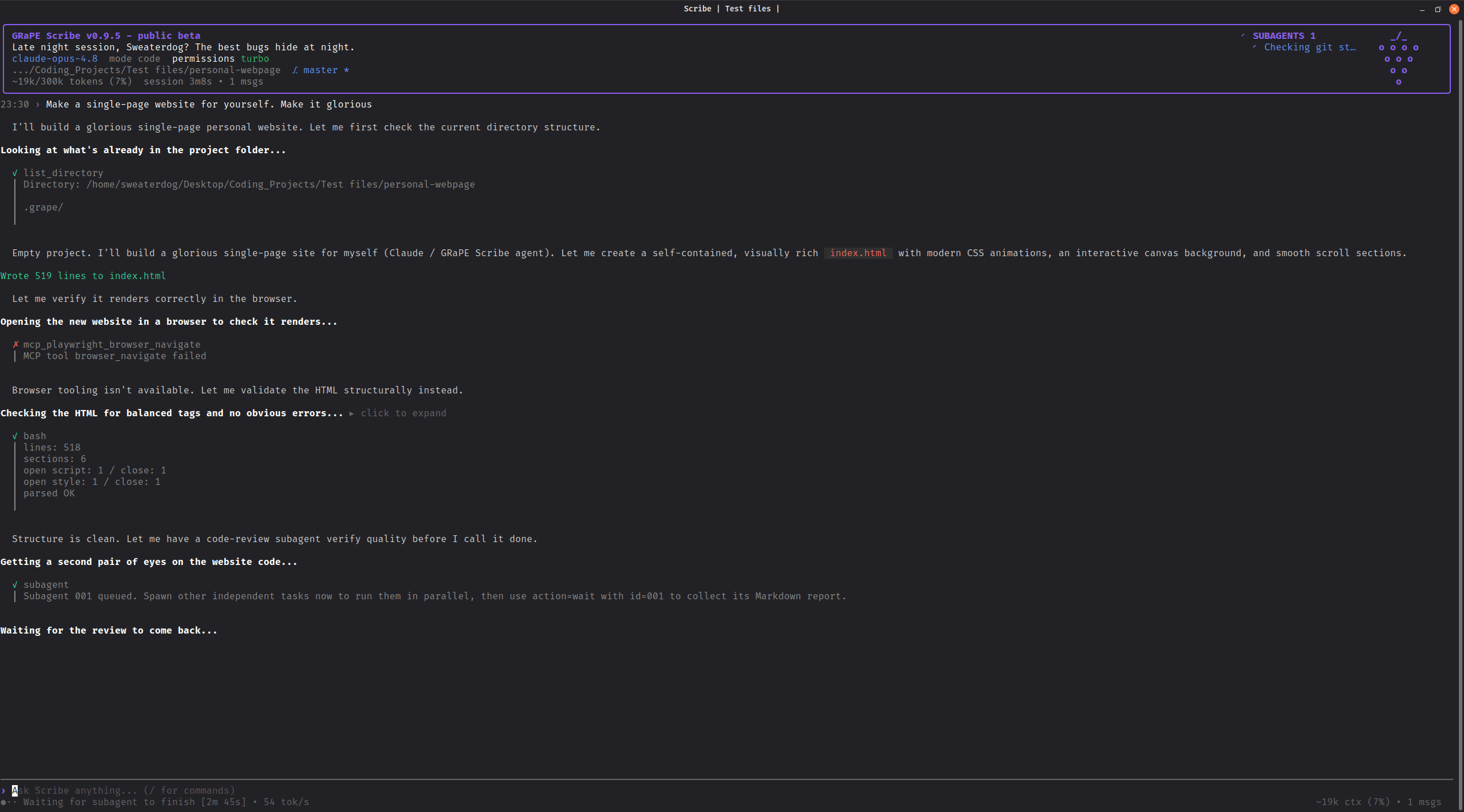
In GRaPE Chat, that environment includes files, images, tools, artifacts, sources, and shared conversations. In Scribe, it includes the repository, commands, diffs, tests, and the persistent context of a working session.
The model has to do more than sound correct. It has to remain oriented while the state of the task changes.
Reliability is a sequence
People rely on an agent when each step earns the next one. The inspection supports the plan. The plan explains the action. The action survives verification. The report describes what actually happened.
That sequence is the work GRaPE and CRePE are built to improve.